
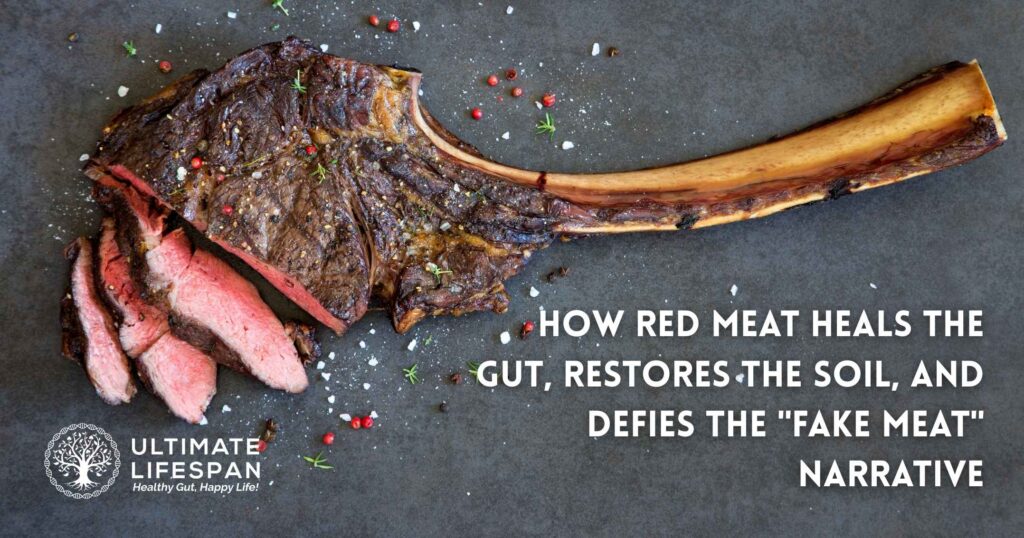
The Meat of the Matter: Red Meat for a Healthier You and a Greener Planet
For decades, we’ve been told a singular, unwavering story: red meat is the enemy. We were taught it clogs our arteries, destroys the environment, and should be replaced with “modern,” plant-based alternatives. But as the tide begins to turn in the halls of government and the fields of regenerative farms, a different truth is emerging. The truth that has been there from time immemorial.
Meat isn’t just a side dish; it is our ancestral superfood. It is the very substance that fueled human brain evolution and sustained our species for millions of years. Today, we are finally peeling back the layers of propaganda to reveal that the problem isn’t the cow—it’s the system. By distinguishing between the industrial machine and the wisdom of nature, we can reclaim our health, heal our gut, and save our soil.
The Great Deception: 80 Years of Anti-Meat Programming
Since the mid-20th century, the American public has been the subject of a massive nutritional experiment. It began with the vilification of saturated fats in the 1950s, fueled by cherry-picked data like Ancel Keys’ “Seven Countries Study.” By 1980, the first official USDA Dietary Guidelines for Americans solidified this bias, pushing a high-carb, low-fat agenda that relegated red meat to the “eat sparingly” category.
This wasn’t just about health; it was about industry. Grains were cheap to produce, easy to store, and highly profitable. Over the next 80 years, this programming convinced us that a “heart-healthy” diet meant bowls of processed cereal and margarines, while a ribeye steak was a “guilty pleasure.”
However, the consequences of this shift have been devastating. Since the introduction of the original Food Pyramid, we have seen a meteoric rise in obesity, Type 2 diabetes, and chronic inflammatory conditions. We traded nutrient-dense animal fats for inflammatory seed oils and refined sugars, and our collective health paid the price.
The 2026 Reset: A New Era for Real Food
In a historic turn of events, the 2025–2030 Dietary Guidelines for Americans (released in early 2026) have finally begun to acknowledge this failure. Under new leadership at the USDA and HHS, the focus has shifted back to “Real Food.”The latest food pyramid has been essentially flipped, emphasizing high-quality proteins, healthy animal fats, and whole foods while calling out “ultra-processed” products. This shift marks the beginning of the end for the anti-meat propaganda era.
The Real Enemy: CAFOs vs. Regenerative Agriculture
When people say meat is bad for the environment or health, they are usually—often unknowingly—talking about CAFOs(Concentrated Animal Feeding Operations). These industrial “factory farms” are a far cry from the way animals were meant to live.
In a CAFO:
- Animals are confined in cramped, unsanitary conditions.
- A grain-based diet (mostly GMO corn and soy) replaces the cow’s natural diet of grass, leading to metabolic distress and the need for routine antibiotics.
- Waste becomes a pollutant, concentrating nitrogen and phosphorus into “lagoons” that leach into our waterways and inevitably come back to us.
CAFO meat is not the same as regeneratively raised meat. The nutrient profile of grain-fed beef is higher in inflammatory Omega-6 fatty acids and lower in beneficial nutrients like Conjugated Linoleic Acid (CLA) and Omega-3s.
The Small Farmer is the Hero
The small-scale, regenerative farmer is not the enemy of the climate; they are the solution. Unlike the industrial model, regenerative agriculture works with nature. It views the cow as an essential part of a living ecosystem. By moving cattle frequently through different pastures—mimicking the movement of wild herds—these farmers ensure the land is never overgrazed and is always naturally fertilized.
Cows are the Solution to Climate Change
The narrative that “cows cause climate change” is a dangerous oversimplification. While it’s true that ruminants emit methane, the context matters. In a regenerative system, cows are actually carbon-sequestering powerhouses.
- Building Topsoil: As cattle graze, their hooves disturb the soil just enough to allow water and seeds to penetrate. Their manure and urine provide a rich, natural fertilizer that feeds the soil microbiome.
- Photosynthesis and Sequestration: Grazing stimulates grasses to grow deeper roots. These plants pull CO2 from the atmosphere and pump it into the soil through their roots, where it is stored long-term.
- Water Retention: Healthy soil rich in organic matter (thanks to the cows) acts like a sponge, holding onto water during droughts and preventing runoff during floods.
Instead of a “carbon source,” a well-managed pasture is a carbon sink. We don’t have too many cows; we have too few managed correctly.
The Nutrient Powerhouse: Why Red Meat is an Ancestral Superfood
Meat is often dismissed as “just protein,” but it is actually a complex “symphony” of nutrients that are nearly impossible to find in the plant kingdom in such bioavailable forms.
| Vitamin B12 | Nerve function & DNA synthesis | Only found in animal products. |
| Heme Iron | Energy & oxygen transport | Absorbed 2-3x more efficiently than plant iron. |
| Creatine | Muscle & brain energy | Virtually non-existent in plant foods. |
| Retinol (Vit A) | Vision & immune health | Pre-formed; plants only offer beta-carotene (poor conversion). |
| Zinc | Immune system & metabolism | Highly bioavailable in red meat. |
For those seeking the ultimate lifespan, organ meats like liver are the true “multivitamins” of nature. Just a small serving of liver provides thousands of times more Vitamin A and B12 than common “superfood” vegetables.
Gut Health: The Foundation of Life
At Ultimate Lifespan, we know that everything starts in the gut. The modern epidemic of “leaky gut” and microbiome imbalance is directly tied to our departure from ancestral eating.
How Meat Supports Your Gut:
- L-Glutamine: Meat is rich in this amino acid, which is the primary fuel for the cells lining your small intestine. It helps “seal” the gut lining, preventing systemic inflammation.
- Low Residue: Unlike many plant foods, meat is almost entirely digested in the upper GI tract. For people with SIBO (Small Intestinal Bacterial Overgrowth) or IBD, meat provides essential nutrition without feeding the overgrowth of “bad” bacteria in the colon.
- Absence of Anti-Nutrients: Many plants contain defense mechanisms like oxalates, lectins, and phytates that can irritate the gut lining and block mineral absorption. Meat has none of these, making it the ultimate “elimination diet” food for gut healing.
The Fake Meat Trap: Ultra-Processed and Environmentally Destructive
In the rushed lie to “save the planet,” we are being sold fake meat—lab-grown cells or plant-based patties. These are not “health foods”; they are the pinnacle of ultra-processing.
Most fake meats are a cocktail of:
- Isolated soy or pea proteins (often grown with heavy pesticides).
- Industrial seed oils (highly inflammatory).
- Synthetic vitamins and gums to mimic the texture of real meat.
Environmentally, these products rely on monocrop agriculture, which destroys topsoil, kills biodiversity (including millions of birds and insects), and requires massive chemical inputs. Transitioning from a steak to a lab-grown nugget is not a step forward; it is a step away from the natural systems that keep us—and the earth—alive and well.
Conclusion: Eat Like Your Ancestors
The propaganda of the last 80 years is crumbling. We are realizing that to live a long, vibrant life, we must return to the foods that built us. By choosing meat from small, regenerative farmers, you are doing three things at once:
- Healing your body with the most bioavailable nutrients on earth.
- Repairing your gut with the building blocks of the intestinal lining.
- Restoring the planet by supporting the welfare of the animals that build our soil.
It’s time to stop fearing the cow and start respecting the cycle of life. Meat is not the enemy—it is the medicine we’ve been looking for.

Sources:
Leroy, Frédéric et al. “The role of meat in the human diet: evolutionary aspects and nutritional value.” Animal frontiers : the review magazine of animal agriculture vol. 13,2 11-18. 15 Apr. 2023, doi:10.1093/af/vfac093
Leroy, Frédéric, et al. “Meat as the Original Superfood: A Concert of Nutrients.” Frontiers in Sustainable Food Systems, vol. 6, 2022, pp. 102-115. Force of Nature Meats.
Sleboda, P., et al. “Not Eating Red Meat is Associated with Reporting the Environment and Climate Change as a Top Concern: Evidence from a National U.S. Survey.” Humanities and Social Science Communications, vol. 13, no. 2, 2026, pp. 45-52.
Priyanjana Pramanik, MSc. Does concern about climate change influence meat choices-New US survey suggests it does. News-Medical, February 9, 2026.
U.S. Department of Agriculture and U.S. Department of Health and Human Services. Dietary Guidelines for Americans, 2025–2030. 10th ed., 2026. FNS Newsroom, fns.usda.gov/newsroom/usda-0003.26.
Van Vliet, Stephan, et al. “Plant-Based Meats, Human Health, and Climate Change.” Frontiers in Sustainable Food Systems, vol. 4, 2020. Frontiers, doi:10.3389/fsufs.2020.00128.
Savory, Allan, and Jody Butterfield. Holistic Management: A New Framework for Decision Making. 2nd ed., Island Press, 1999. Internet Archive, archive.org/details/holisticmanageme0000savo.
About the Author Buck Rizvi
Founder for Ultimate Lifespan. Natural Health Researcher & Evangelist. Father of four. Instrument-rated pilot. Still has trouble impressing his wife and best friend, Daiva.


Popular posts
Session expired
Please log in again. The login page will open in a new tab. After logging in you can close it and return to this page.