
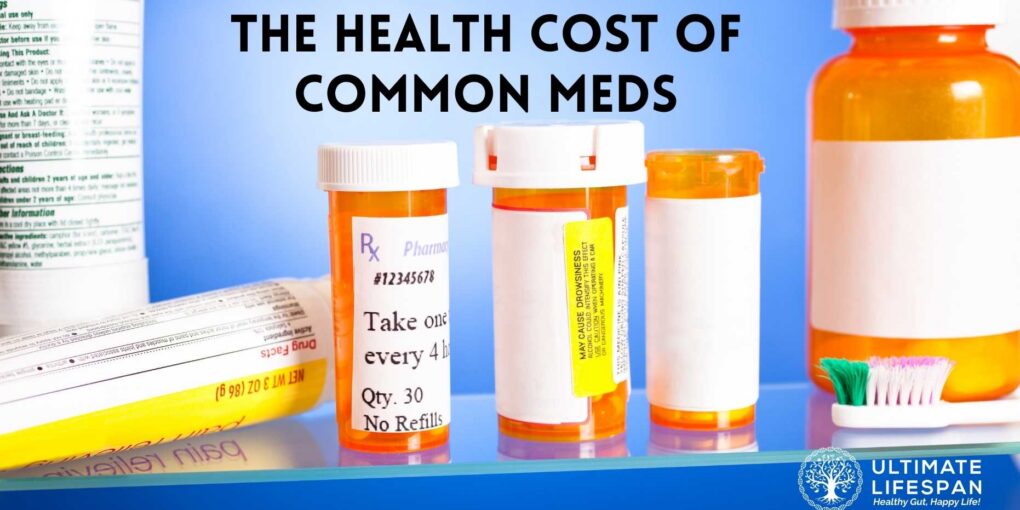
Is Your Prescription Wrecking Your Gut?
Every morning, millions of Americans follow a familiar routine: they reach for a glass of water and swallow a small pill—sometimes three or four. These medications are often prescribed to “manage” things like high blood pressure, thyroid levels, or cholesterol. In the short term, they keep numbers on a lab test within a “safe” range.
However, there is a silent conversation happening inside your body that many people never hear. While these medications work to suppress symptoms, they often act like a “wrecking ball” to your digestive system. Understanding the link between medication and gut health is the first step in protecting your master system from long-term damage.
Your gut is the foundation of your entire body. It is home to 70% of your immune system and trillions of bacteria that control your mood, your skin, and your energy. When we use drugs to hide a symptom without fixing the root cause, we risk destroying this foundation. This often leads to a “prescription cascade”—where you end up taking more drugs just to fix the side effects of the first one.
To find your way back to true health, you must understand how the top three most prescribed medications in the U.S. affect your gut environment.
The Cholesterol Myth and Atorvastatin
Atorvastatin (Lipitor) is a “statin” designed to stop your liver from making cholesterol. But here is a truth that is often overlooked: cholesterol is essential to life, that's why the liver makes it. It is the primary building block for your hormones, it protects your brain, and it helps your body make Vitamin D.
Firing the Firefighters
Cholesterol is not the “cause” of heart attacks. In many cases, cholesterol levels rise because of systemic inflammation. Think of cholesterol like a firefighter: it shows up at the scene of a fire (inflammation) to help repair the damage. Statins simply “fire the firefighters.” This does nothing to put out the fire or address why the inflammation started in the first place.
The Gut Cost: Leaky Gut
Statins can be very harsh on your gut lining. Your gut is supposed to act like a “screen door.” It lets healthy nutrients into your blood but keeps toxins and undigested food out.
Recent studies, including research in the Frontiers in Microbiology (2022), show that statins can weaken this screen door. This leads to Iintestinal permeability, or “Leaky Gut.” When the gut leaks, tiny bits of waste slip into your bloodstream. Your immune system sees this and panics, causing even more inflammation. This creates a vicious cycle where the drug causes the very inflammation that makes your body want to produce more cholesterol to fight it, but now it can't even do that, because the statin is stopping that very process.
Thyroid Meds and the “Conveyor Belt” Jam
Levothyroxine (Synthroid) is a synthetic hormone used to “manage” an underactive thyroid. Many people take it because they feel tired or have a slow metabolism. However, this pill doesn't “cure” the thyroid; it just replaces what the body isn't making.
Ignoring the Root Cause
The thyroid usually slows down because of gut issues (SIBO), stress, or lack of minerals. Simply adding a synthetic hormone doesn't fix these problems. It’s like putting a band-aid on a deep wound without cleaning the wound first.
The SIBO Connection
Your gut has a built-in “conveyor belt” called motility. This keeps food moving so it doesn't rot or grow bad bacteria. Thyroid hormones power that conveyor belt.
When you take synthetic hormones, your levels can fluctuate. This often causes the “conveyor belt” to slow down. When it slows down, bacteria that belong in your large intestine start to crawl upward into the small intestine. This is a condition called SIBO (Small Intestinal Bacterial Overgrowth), which most likely started the whole thyroid issue in the 1st place.
Research shows that people on thyroid medication are more likely to develop even more SIBO (Brechmann, Thorsten et al.). This leads to extreme bloating and gas right after you eat, which further damages your gut and makes it harder to absorb any nutrients at all.
Blood Pressure Pills and the “Lazy Gut”
Amlodipine (Norvasc) is a “calcium channel blocker.” It works by relaxing the muscles in your blood vessels so your blood pressure drops. But again, this just manages a number. It doesn't address why your blood pressure is high—which is usually due to poor diet, lack of minerals like magnesium, or chronic stress.
Chronic Constipation
The problem is that your heart isn't the only thing made of muscle. Your entire digestive tract is a long tube of “smooth muscle.” Amlodipine doesn't just relax your blood vessels; it “relaxes” your gut muscles, too.
When your gut muscles relax too much, they stop pushing waste out. This leads to chronic constipation. Clinical data from 2011 shows that people on Amlodipine have a much higher risk of severe constipation (ISRN). When waste sits in your colon for too long, toxins are reabsorbed into your blood, making you feel sluggish and sick.
The Reflux Trap
Amlodipine also relaxes the “trap door” at the bottom of your throat (the LES). When this door stays open, stomach acid splashes up, causing acid reflux. Many people then start taking another pill for heartburn, which lowers their stomach acid even more and makes it impossible not only to digest protein correctly, but leaves you susceptible to a plethora of other health issues.
Low stomach acid can lead to poor protein digestion, mineral and vitamin deficiencies (especially iron, calcium, magnesium, zinc, and B12), increased risk of infections and parasites, food sensitivities, bacterial overgrowth, bloating and reflux, and long-term digestive and immune dysfunction. This will most likely lead to not one more, but multiple medications to “manage” the new symptoms caused by the 1st drug.
Stop the Prescription Cascade
This is how many people lose their health: they take a pill for blood pressure, which causes reflux. They then take a pill for reflux, which causes a bacterial overgrowth. Then they take a pill for the bloating. Then they take a pill (antibiotic) for bacterial infection, which makes the next infection even worse.
Within a year, they are taking five medications. None of these drugs “cure” anything; they only suppress symptoms. Meanwhile, the original problem—usually a lack of nutrients or a toxic gut—gets worse and worse. This is the polypharmacy train (you don't want to be on), and the best way to get off it is to focus on your foundation.
Common Medication Side Effects on Gut Health: Solutions
If you want to restore your body to its natural state of balance (homeostasis), you must change the environment inside your body. One of the most powerful ways to do this is by following the Wise Traditions diet. This approach is based on how our ancestors ate before modern, processed foods took over.
Focus on Healing Fats and Real Food
Instead of fearing cholesterol eat traditional fats like grass-fed butter, tallow, and lard. These fats provide the fat-soluble vitamins (A, D, and K2) that your heart and thyroid actually need to function.
To lower systemic inflammation and support your “Master System,” try these steps:
- Eat Fermented Foods: Foods like raw sauerkraut or kefir provide natural probiotics that help repair a “leaky gut” caused by medications.
- Drink Bone Broth: Homemade broth is rich in collagen and amino acids that act like “glue” to seal the gut lining.
- Soak Your Grains: If you eat grains or nuts, soak or sprout them first. This removes “anti-nutrients” that can irritate a drug-compromised gut.
- Avoid Seed Oils: Get rid of “industrial” oils like canola, soy, and corn oil. These are highly inflammatory and are a major reason why the liver produces excess cholesterol in the first place.
Use Targeted Support
When your gut is struggling with the side effects of medications, it often needs extra help.
- Enzymes: Since meds like Amlodipine slow down digestion, taking enzymes can help break down food so it doesn't sit and rot in the gut.
- Probiotics: These help replace the “good guys” that statins often destroy.
- Gentle Fiber: To help a “lazy gut” move waste out without causing more gas or pain.
Conclusion: Protect Your Master System
Modern medicine is great for emergencies, but it is not a substitute for a healthy foundation. Taking a pill to lower a number and think you are healthy, is the same as using a credit card and thinking you have money.
If you are taking Atorvastatin, Levothyroxine, or Amlodipine, remember that these drugs are not “fixing” the cause of your imbalance. To truly heal, you must support your digestive system. When your gut is healthy, your body can naturally manage inflammation, balance its own hormones, and keep your blood pressure in a healthy range.
Don't just manage the symptoms. Restore the master system.
Sources:
Cheng T, Li C, Shen L, Wang S, Li X, Fu C, Li T, Liu B, Gu Y, Wang W and Feng B (2022) The Intestinal Effect of Atorvastatin: Akkermansia muciniphila and Barrier Function. Front. Microbiol. 12:797062. doi: 10.3389/fmicb.2021.797062
Brechmann, Thorsten et al. “Levothyroxine therapy and impaired clearance are the strongest contributors to small intestinal bacterial overgrowth: Results of a retrospective cohort study.” World journal of gastroenterology vol. 23,5 (2017): 842-852. doi:10.3748/wjg.v23.i5.842
Saha, Lekha, and Chander Shekhar Gautam. “The effect of amlodipine alone and in combination with atenolol on bowel habit in patients with hypertension: an observation.” ISRN gastroenterology vol. 2011 (2011): 757141. doi:10.5402/2011/757141
Cohut, Maria. “Common Drugs May Alter Gut Bacteria and Increase Health Risks.” Medical News Today, 23 Oct. 2019.
“11 Principles Overview.” The Weston A. Price Foundation, https://www.westonaprice.org/health-topics/11-principles-overview/. Accessed 10 Mar. 2026.

